Showing posts with label community. Show all posts

Thursday, March 15, 2012

Bruno Latour and Leslie Knope

Juxtapositions are frequently fruitful. I am not sure where this one is going, but it's pretty sweet.

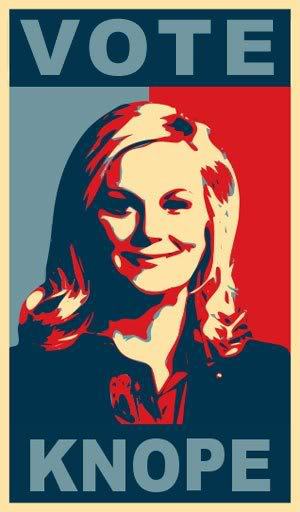
I've been re-reading Bruno Latour's Aramis and re-watching Parks and Recreation. Shot in the documentary style of The Office, the show increasingly strikes me as a performance of what Latour describes in Aramis as a "relativist sociology": "It does not know that society is composed of, and that is why it goes off to learn from others, from those who are constructing society" (200). Parks and Recreation is a portrait of government in action. Leslie Knope, of the Love of Local Government.

The show, at its finest, performs the work of negotiation and compromise that, in part, shapes civic life. In re-watching these moments with Aramis by my side, I can't help but see Leslie through Latour's eyes:
Bureaucrats are the Einsteins of society. They make incommensurable frames of reference once again commensurable and translatable. The protocol of agreement, red-penciled and ratified, starts moving again, going from one reference body to another, tracing a path along the way, a succession of fragile catwalks that make the agreement harder to break each time, because it is now weighed down with the word of the State.
Final shot of "Harvest Festival"
Part of the reason I love the show is its tempered faith in bureaucrats. Leslie Knope, the deputy director of the Pawnee, IN, Parks Department and star of the show, is an earnest, hardworking civil servant. She does her job amidst the incommensurability of democracy, balancing the angry feedback she receives at public forums, this disinterest and/or lack of faith in government, the libertarianism of her boss, budget constraints, etc. (The episode in Season Three when Leslie and the Parks Department pull-off the Harvest Fest may provide one of the most satisfying endings of a sitcom episode ever.)

I'll grant anyone, for the moment, any joke or insult about civil servants and bureaucrats. Yes, yes. But I ask, in light of the kind of sociology that Latour proposes, what does such a view, nearly ubiquitous outside of Parks and Recreation, get us? How do we benefit from demeaning such work (other than getting exactly what we deserve)? How do we learn to do it better by dismissing it out of hand? In rushing to judgement, we glass over the decided-ness of what we hold near and dear. We short-circuit democracy.

I'd argue that lurking beneath such a short-circuiting contempt is what Latour calls "classical sociology":
There are norms, and thus there are deviations with respect to the norm; there are reasons, and thus there is irrationality; there is logic, thus there is illogicality; there is common sense, and thus perverted senses; there are norms, and thus there are abnormality and anomie. (199)
When I watch Parks and Recreation I am not watching a documentary where "the actors are informants," telling what they did so that we can pass judgement (although certainly this happens: I can easily imagine a classical sociological viewing of the show). For me, I am watching government in action. Parks and Recreation is not a show where common sense, and logic, and reason are outside measures applied to political behavior; it is, at its best, a show where common sense, logic, and reason are all the end results--the effect--of political behavior. For instance, the reasonableness of the park Leslie wants to put in the vacant lot (this is the primary arc of season one) cannot be known ahead time: its reasonable-ness, its sensical-ness, its feasible and, finally, its reality are precisely what is being worked on. To borrow from Latour, things like logic and common sense "follow; they do not lead. They are decided; they are not what makes it possible to decide" (184).

As Leslie says of her first public forum (which goes terrible and to great humorous effect): "God I loved it. I loved every minute of it!"

Tuesday, March 6, 2012

Urbanized and Object-Oriented Rhetoric

So I recently (and finally) watched Urbanized, the final installment of Gary Hustwit's Design Trilogy, which includes Helvetica and Objectified. While the first two documentaries look a smaller scale design (graphic design and industrial design respectively), Urbanized looks at urban design and urban planning: design at the level of society (which is certainly not to say the two previous documentaries don't bear on society as well). I have taught Helvetica in professional writing and technical communication and Objectified in a New Media and Rhetoric course. Indeed, the latter inspired this documentary that my students and I made:


The Rhetoric of the City Museum from Nathaniel Rivers on Vimeo.

And I am likely to teach all three in my Fall 2012 Problems in Rhetoric: Animal, Vegetable, Mineral course, which takes aim at nonsymbolic and nonhuman rhetoric, which I see as the key aspects of material and object-oriented rhetorics.

In terms of the nonsymbolic and nonhuman, Urbanized, like the whole trilogy, does a good job with nonsymbolic rhetoric: how we move one another in nondiscursive ways. For instance, how high quality bike lines can raise the social status of cycling and demonstrate that a person on a $30 bikes is as valuable in a democracy as someone in a $30,000 car. Watching Urbanized, I was reminded of James Fredal's Rhetorical Action in Ancient Athens, which argues that any attempt to understand Ancient Athenian rhetoric must account for the design and planning of the city of Athens itself--it's materiality.

Where the documentary falls short (and even this is unduly harsh as it does so much so well) is with respect to the nonhuman. As the film's emphasis is design, that it centers around the human should come as no surprise: those designing, building, and dwelling in cities are it's focus. (Although even here, the documentary could have attended to the materials with which the designers work and how those materials shape the design and building processes.) That said, the very materiality of the film itself calls our attention to the nonhuman: visually, the documentary is in love with the materiality of the city.


If anything, between the voices of the individuals interviewed (multiple interviewees rather than a single narrator, provide the dialogue of the documentary) and the visuals provided by the cinematographer there is an enactment of the human/nonhuman dynamic. As I watch the documentary, then, I feel the tug between the nonhuman that "speaks" for itself and the humans who claim to speak for it or reduce it to their intentions. [I'd also grant that in subsequent viewings I will find additional moments where the documentary foregrounds the nonhuman, granting it agency and ontological weight.]

In short, as I watch Urbanized I kept asking Bruno Latour's twenty-year-old question: "Where Are the Missing Masses?" And the ending of the documentary is telling in terms of how the missing masses--the nonhuman objects that are part and parcel of our urban spaces and our lives as we know them--go missing, how there are silenced or erase. The final, human voice (I can't recall the fellow's name and I don't want to look it up right now) of the documentary argues:
Fundamentally, as a species, we need things [I got hopeful] that can power our imaginations, that get our our passions going, that can give us a sense of meaning. And that is not a brick; it is not a pipe. It is an idea. That's what drives cities forward.
And while I would not totally disagree, I would say that it is precisely in the name of bricks and pipes and their agency in the movement and development of cities, that object-oriented ontology, or object-oriented rhetoric more specifically, (must) makes its intervention. To reduce cities to the meaning the provide for us and the ideas we can have about or build into them, irrespective of the city's thing-ness and of the many other nonhumans that shape that city and its inhabitants, is to miss a substantial portion of what it means to be urbanized.

I would never argue that design doesn't matter; the documentary makes a pretty damn good case that it does. I would argue though that design cannot be flattened out into a solely human affair. What is buried in the documentary, underneath the persuasive argument that bad design on the part of humans produces bad effects, is that bad (however and whoever defines that) urban spaces are due in part to designers and design that ignore the rhetorical agency and ontological weight of the nonhumans that were always part and parcel of that design. Bad design is design that mistakes itself as purely human. If we ignore the missing masses as "we" plan, they will come back to haunt us precisely where we live.

UPDATE: There's a Part Two.

At some point, after I teach them, I want to write something longer and more involved about Hustwit's trilogy in light of new materialism and object-oriented ontology. That is, your feedback would be greatly appreciated.

Wednesday, September 1, 2010

You Are Where You Picnic

Sarah Williams Goldhagen, architecture critic at The New Republic has a splendid review of and essay on several, recently completed public parks (including Chicago's Millennium Park, pictured below). Like the environmental artist Christo, Goldhagen, in this and other essays, treats of the political, social, and economic work that gives rise to architectures and the the political, social, and economic work done by architectures. She thus treats, in my mind, the double work of rhetoric and materiality. The architecture,as the material, works to shape the public, its movements, its values, and its future. However, the material, the architecture is not pre-specified and automatic: it must be made and it is made rhetorically.

Wednesday, April 28, 2010

A Technique of Assent

So, my first graduate seminar concluded yesterday with the sharing of papers and the passing of pitchers. Before we moved from the classroom to the barroom, I shared these final thoughts:
I want to conclude the semester by suggesting another way of reading and engaging texts—one I feel is an alternative to common, critical engagements with texts that operate in the negative register (e.g., what does this text leave out, overlook, or otherwise exclude, simplify, or gloss?). This is not to say that such readings are unproductive or unnecessary (as such readings are often both productive and necessary).

It is to suggest other ways of reading that mine each and every text for something that can be “taken away,” “augmented,” “adopted,” or “utilized.” It is a way of reading that leaves one open to persuasion—to approach a text perfectly willing to be “converted to the enemy's camp.” And it is a way of reading that generates new questions, new ideas, and new ways of thinking.

Here are some sample texts from this semester that suggest and enact such approaches:
  1. Muckelbauer’s “reading productively” or “affirmatively”

  2. Gorgias' rescuing of Helen

  3. Jarratt’s re-reading of the sophists

  4. Rickert’s use of Plato’s chôra

  5. Burke’s notion of “discounting”

  6. Corder’s invocation of “love”
This technique of assent is also a reminder that readings in the negative register (where a text is “problematized”) are likewise always already acts of assent: every no bellies a previous yes. From where do we say “no,” and by what "yes" are we enabled to do so? Opening or starting with the "yes" may very well highlight the assumptions upon which our critical responses are based (or cultivated).

I likewise find this technique of assent—as a pattern of response or habit—very helpful for my work as a teacher (and all scholars are, I hope, teachers). And not just because teachers should be generous or “nice” (which they should be), but because one of the joys of teaching is learning. How does the thinking of students and their work productively change my own thinking or teaching practices? What can I, in other words, take away from each and every class and student?

Finally, another excellent reason for affirmative readings or this technique of assent is this: you will come to publish scholarly works many of you. And these works will enter into a community of scholars. Articles written in the safety of solitude will go out into the world and be read by others. What are your obligations to other scholars and their work? How do you want to position yourself within a community of scholars? How do you want to respond to and assent to the work of others?

Tuesday, April 6, 2010

U.S. Board on Geographic Names

Easter Break and trip back to S. Indiana (which entails intermittent internet access) has prevented me from blogging for a bit. I am going to sneak a short one here to get back into the swing of things.

This from a Los Angeles Times story on the agency, named in my title, that is
responsible for deciding the names of natural features, including glaciers, mountains, valleys, rivers and ponds.
Now, I obviously love this sort of thing because it draws attention to the inherently political/rhetorical act of naming: no naming is value-free or "innocent." Additionally, the presence of a board to adjudicate such matters (the board does not propose names; it only acts on suggestions from citizens) reminds us that because naming is value-laden it is necessarily contested. Names matter and so we fight about them (or, better yet, we all know they are important because we fight about them, which is to say that if they were indeed value-free and innocent we wouldn't care one way or the other: the proof of my argument is in the argumentative pudding).
Soon the naming authority will find its own name in the spotlight.

In an upcoming decision, the panel will take up a controversial request by a Bay Area man who filed a request to change Mount Diablo in to Mount Reagan because he finds the name, Spanish for "the devil," to be offensive. His request touched off a flood of Internet opposition, and the Contra Costa County Board of Supervisors voted against the idea and sent an opposition letter to the federal panel.
Given that the board has recently approved the name "Devils Anvil Peak," it seems unlikely that they will likewise find "Mount Diable" offensive. Now, of course there will be cries of "politicization of the naming process" and howls of "why does everything have to be so political?" I have suggested it is inherently political, and I would suggest that such instances serve as uncomfortable reminders of this. And I would conclude this short blog by suggesting that complaints of "politicization" come not just from those who disparage politics but from those who lose naming contests.

Friday, March 26, 2010

Gut Over Glut

Introduction
In 1990 Carolyn Miller took decision science ("a theory of choice with an accompanying battery of 'decision aids' for 'modeling problems of choice' in management and public policy"(163)*) to task for both what Wayne Booth calls motivism and for what Chaim Perelman refers to as reducing "problems of action" to "problems of knowledge." Miller dings decision science for a few other things; I am interested only in these two for my present purposes (as I am likewise thinking about my Computers and Writing presentation in May): the dangers of motivism and the action/knowledge problem in public life and how rhetoric should respond pedagogically.

Troubling Decision Science
Miller defines decision science as a kind of rhetoric in that it is a "theory of choice" (163). Nevertheless, Miller argues it is a problematic rhetoric because it abdicates or avoids reasoning about values, what Booth terms motivism. My more cynical response is that those folks in economics and management who typically employ decision science are avoiding addressing values purposefully to prevent them from being challenge (but this is, perhaps, another problematic kind of motivism that Burke admonishes against).

The second issue Miller addresses is how decision science boils problems of action (what should we do? should we do something at all?) down to problems of knowledge (how much will is cost? what are the risks and rewards?). The problem is that in reducing action to knowledge decision science erases conflict and avoids the question of values.
Problems of action involve conflict between people; even solitary deliberators negotiate conflicts between possible versions of themselves. Problems of action are "essentially contestable"; problems of knowledge are not. (175)
Decision Science Troubles the World
For example of how both aspects of decision science problematically operate out in the world (one of Miller's chief concerns), I would draw our attention to the NOVA documentary "The Spy Factory". The oddly titled documentary explores the role of the National Security Agency (NSA), in combination with the FBI and the CIA, in the "intelligence failures" preceding and following the 9/11 terror attacks. In particular, the issues of motivism and problems of action/knowledge show-up in the Bush administration's response to those attacks. (Obviously, this blog post is limited and much of the work now being done within the intelligence services is to be commended. This post and the documentary it draws on have a necessarily limited perspective. That being said, I am responding to stated desires and policies.)

In brief, the Bush administration's response was to remove barriers to searches and spying so as to increase the amount or volume of information available to our intelligence agencies. Many critiques of this policy -- beyond the legal and moral ones -- persuasively point out that information or the lack thereof was not the issue -- was not the root of the problem. There was enough intelligence in terms of raw data. Indeed, the ease with which government investigators were able to piece together the events leading up to the attacks suggests as much. The problem was a problem of action, of value-laden decision-making (not "do we have enough information?" but "should we be sharing it with other agencies and how and when?"). What was required, to borrow from Miller, was an ability to reason about values, about the culture of the intelligence community, and about how information was allowed or not allowed to circulate. Most importantly, however, reducing this problem of action to a problem of knowledge has potentially threatened core legal principles and not made us all that much safer. A primary contributor to the documentary, and a long time historian of the NSA, concludes the NOVA documentary this way:
Is this flood of information making us any safer? [...] We should have been safe the way it was [...] How much information is enough -- and won't too much information end up making the world more dangerous?
At first this seems counter-intuitive: how can too much information be a bad thing? If you are a decision scientist and assume that "if our information were more complete or our calculations more accurate, we could know with complete certainty whether it will rain today" (Miller 175), then it very much is against your intuition. However, if the problem is one of action (one of human relations and values and contingencies and probabilities), which I think it is, then it is rather reasonable to question the absolute value of information. And I would suggest, as I move to conclude this discussion in rhetoric's pedagogy, that it is precisely in the direction of intuition/instinct that we should head.

Conclusion: Rhetoric's Pedagogy for Deciding
To return to Miller's assertions for a rhetorical understanding of decision science (and for an accounting of how decision science has influenced pedagogy and so impacted decision making), I would ask what all this means for rhetoric's pedagogy. How might those of us in rhetoric teach decision-making in and against the context of decision science?

If traditionally education has been about information (P. Friere's influence notwithstanding), what do we make of such persuasive arguments against decision science, which is largely predicated upon this Enlightenment ideal? I would propose (although I am far from the only one) that rhetoric draw on recent research on instincts and gut feelings. For instance, the work on Gerd Gigerenzer and his book Gut Feelings: The Intelligence of the Unconscious is quite informative (yikes!) in this direction. I argue that an education that would avoid motivism and the reduction of action to knowledge should focus less on "information" and more on "instinct."

I like a focus on instinct because instincts become an excellent way to address how we reason about values. In essence, instincts are about response-ability. They are about patterns or habits of engagement. Instincts filter what information counts as valuable and they motivate particular actions over others. Instincts are, in other words, were the rubber of values meets the road of action. Values, however, and as Gigerenzer argues, are not beyond human (pedagogical) agency and they are not automatic. Instincts, he argues, are cultivated. Instincts are neither value free nor beyond rhetorical deliberation and persuasion. Indeed, instincts must necessarily be cultivated precisely because they are not pre-specified (we could take numerous examples of this from athletics where it is the honing of instincts that is so much a part of practice and improvement. The work of Debra Hawhee is valuable in this regard).

In addition to being a call to discuss values (or patterns of response), instincts are a way around one of the oft-described problems of teaching rhetoric, which presumes to address the contingent and situational (thus making the teaching of formulas problematic). Rhetoric strikes me as instinctual (which are always geared towards problems of action) rather than formulaic (which strikes me as largely focused on problems of information). I would argue that what we (should) teach are instincts. In so arguing, I necessarily invite a discussion about what kinds of instincts. And it is a discussion of what instincts and what values we should teach that potentially protects us from the troubles of decision science and from the charge of motivism, which is as damaging to teachers as it is economists.

*Miller, Carolyn R. "The Rhetoric of Decision Science, or Herbert A. Simon Says." The Rhetorical Turn: Invention and Persuasion in the Conduct of Inquiry. Ed. Herbert A. Simon. Chicago: University of Chicago Press, 1990.
Tuesday, March 9, 2010

Census Communus

Yesterday we received our pre-Census letter, which informs us that the 2010 Census is on its way. The letter, however, does more than this: it attempts to persuade us that completing and promptly returning the 2010 Census is vital. Let me start by saying that so do I. I think it is important that everyone is counted so that everyone, in a certain way, counts. This does not mean to say that I think the Census is perfect. There are important debates about how it counts, how it organizes people into categories, etc. What I find interesting about this letter is the particular pitch it makes and what that pitch says to us about what we think democracy is all about.

A colleague of mine in the Government Department has written a book, Democratic Faith, that describes what he calls "a state of quiet crisis" in democratic theory. His introduction, which is all I have read so far, explores the tension between the idea that democracy "takes men as they are" and the idea that people must be fashioned for democratic life. "While claiming to take 'men as they are,'" he writes,
democratic theory from its inception, even to its dominant contemporary expressions, exhibits anything but satisfaction for the civic capacities of ordinary humans, and seeks, sometimes to a major extent, to alter that condition for democratic ends.
As a teacher and researcher in rhetoric and writing, I can attest to this tension, while freely admitting that I do not feel it as strongly. I very much see my pedagogy as focused on something like citizenship: that the ability to engage others rhetorically through writing and other forms of composition is vital to the life and health of democracy. I see cultivating (better) citizens as necessary because I do not find democracy (nor any other form of government) "natural." I do not feel that if only we somehow removed all external forces humans will naturally desire democracy.

I believe this, in large part, because much of my research is centered around the idea that much of what we take as "natural" in human beings is cultivated or inculcated. Forms of government do simply arrive after the fact of subject formation and then are either accepted or rejected (America's recent efforts at "nation building" certainly point to this fact). Societies, with their cultures and forms of government, fashion their own subjects both implicitly and explicitly. I see my pedagogy as in largely in the "explicitly" category. A government is not simply added to already existing subjects, but is, in many important ways, the sub-stance of subjectivity itself. But this moves me in other directions.

So I return then to this pre-Census letter:
Your response is important. Results from the 2010 Census will be used to help each community get its fair share of government funds for highways, schools, health facilities, and many other programs you and your neighbors need. Without a complete, accurate census, your community may not receive its fair share.
Obviously, one would take more time and care in conducting a fully rigorous rhetorical analysis, but a few things strike me as obvious here:
  • "get" and "receive" are prominent (essentially, the same notion of "getting" appears twice in a very short letter)
  • what we get are "funds" (for important things, mind you)
What isn't mentioned, or what is implied we could say generously, are notions of representation, a sense of gaining an understanding of the changing demographic landscape of the United States, and many of the other things Census data can be used for. Also, no appeals to citizenship are made: "fill this out because you live here." "Freedom Isn't Free - All True Patriots Complete the Census."

What is valuable about democracy, this letter argues (as I have haphazardly read it) is its ability to satisfy individual or group interests. I want to be careful here, obviously. Fair and equitable distribution of resources is about more than self-interest. Indeed, the allocation of government resources is one of the primary ways we manifest our values. What I focused on is the appeal made here. The appeal is not social (I recognize the use of community and the "your neighbor" line) in any meaningful way. In fact, as I read it, "community" in the first line is always about "your community" in the last line. What about communities that are not mine--neighbors that are not mine? The 2010 Census, and thus, I would argue, democracy, is about you getting what you want. There is no sense here (or not enough for me, at least) of what my colleague in Government calls "civic excellence."

In conclusion, I am not all that impressed with this letter and the perspective on democracy it bellies (I would not, however, automatically attribute these values to the author of the document--many civil servants are clearly not just in it for themselves). Nor would I say that I am surprised. I will not, however, despair; I have a rhetoric and writing class to plan.

Sunday, February 28, 2010

Cave symbols hint at 30,000-year-old origins of written communication

As the researcher says, "language maybe too strong a word," but two things here strike me as important:
  • concepts that cannot be drawn
  • social agreement on meaning
Still chewing on this one for now.

Here is the researcher's article in the New Scientist.

And here is another news story on the research.

Tuesday, February 23, 2010

Day 12: Cultures in Sports

As I mention in my Day 9 post (Bodies in Sport):
For reasons that will become clear, I appreciate the way NBC covers the Olympics: they frequently jump from sport to sport. [...] The reason I happen to like this, given my own research interests, is that we get to see the variety of bodies (body types) that participate in sports and, from this, the relationship between body and sport. Moving from the Bobsled [...] to speed skating [...] and then to short track speed skating [...] is an exercise in the varieties of human embodiment.
It is likewise interesting to the see the move from sport to sport in terms of nationality. That is, what nations excel at what sports? As I write, America and Germany go down the wire in Team Nordic Combined. A few channels over, Canada is destroying Germany in hockey.

I don't have much new to say here, as I have already been dealing with this issue tacitly throughout my Olympic posts. It does, however, corroborate my points about bodies. It would be silly to argue that Germany simply doesn't have inherently talented hockey players; that the genetics of Germans have not mixed in just the right way to produce hockey excellence. It probably isn't simply access to ice either. Germany does not suffer from tropical climes that might work against success at cold, winter sports. They are currently in second place in the overall medal count. And as my German friend has reminded me, because of Germany's population this is rather impressive medal production. It seems far more plausible that Germans, by and large, have simply not invested in hockey for whatever reason. A cultural "decision" has been made with respect to hockey, and that call means that tonight Germany went down to Canada 8-2.

Tuesday, February 16, 2010

Day 5: Olympians and the Rest of Us

Part of my dissertation research examined the success of Usain Bolt in terms of his cultural context. Mainly, that because one can earn a significant reputation as a track star in Jamaica, it makes it more likely that more individuals will embark on such a career and stick with it. This is confirmed by research in the sociology of sport, which shows that one of the defining features of athletic success is an athlete's social network. Christopher L. Stevenson argues that athletes become athletes through "processes of entanglements, commitments, and reputations and identities." Stevenson examines how athletes are recruited into the sports and by whom. He then describes how, through a series of deepening entanglements and commitments, the athlete’s identity becomes bound-up in the sport through these relationships and through the reputation he or she earns.
These webs of relationship entanglements drew the athlete into the sporting activity, and the athlete allowed him/herself to be drawn in because of the value he or she place those relationships.
I argued that Bolt comes from a country whose national attitude means reputation for track athletes. Jamaican journalist Colin Channer offers a distinctly non-biological explanation for the strength of Jamaica’s sprinters. He traces the focus on sprinting to elements of Jamaican culture and history. While he admits that the love for speed “seems at odds with its hard-nose commitment to nonchalance,” “to be Jamaican means to move.” The Jamaican-born Channer argues that the love of sprinting “is rooted in the notion of flight, in the notion of defiance and aspiration expressed in the grammar of the body." The Jamaican track phenomenon is not directly traceable to either its geography or to the “unique biology” of its inhabitants; Jamaicans share both with countries with far less success in sprinting. Channer further argues that “sprinting is the physical argot for the runaway slave. For a slave, escape was act of defiance, a loosely punctuated treatise, with commas and no full stops, on the topic of being free.” Running as an act of defiance reflects the deeply rooted narrative of the maroons, resistance groups constituted by runaway slaves who fought the British from 1655 to 1796. So while Channer argues that Bolt “has been fast ever since we’ve known him,” he is from a place culturally committed to cultivating speed.

What I make of this is that athletic and, thus, Olympic success depends, in part, on a culture that cultivates it. Having access to mountains and snow is certainly important, but there must likewise be a cultural climate that values and rewards it. That is, Olympians need other people interested in their sport to make excelling in that sport rewarding in terms of reputation and identity. They likewise need cultural pressure to do the same (the cultural risks inherent in failure). This becomes important in acknowledging and explaining the absence of success in a sport and how policies around sports matter. This is particularly relevant when sports are discussed in terms of gender and race. Do we as a society make it worthwhile for individuals to choose to compete in certain sports? This connects to my earlier post about the IOC's decision to excise softball. If there is no chance of Olympic gold, what "entanglements, commitments, and reputations and identities" will exist to cultivate athletic excellence?

Saturday, February 6, 2010

Local News is Local News is Local News

Under the barrage of heavy, wet snow and near constant news coverage of the "Super Storm 2010," I have some observations about local news affiliates. In brief, I observe that local news somewhere is local news everywhere. Moving from WLFI (Lafayette) to WUSA (D.C.) was not a huge transition. The toys are better, there is slightly less screen-awkwardness, but the heart and the approach is the same.

There is, in general, a strange and incongruous mix of helpful and detailed information (the stuff national news can't or won't cover) and then huge helpings of the inane and goofy. Want to know how the roads are, what the snow is like to drive on, the emergency numbers for various utilities, warnings about snow emergency routes, warnings to stay off the roads for the benefit of snow plow drivers and power company trucks, and a good sense of how neighbors are handling and responding to the storm, I find the local news comforting and informative and intimate. The woman on the t.v. knows where I live.

And then, of course, there are the goofy graphics, the on the scene reporter using a plastic toy car to describe road conditions, another reporting banging his ice scraper with his snow shovel to show how thick the ice is, that other reporter wearing the ski goggles for some reason, and that other one driving around with a web cam attached to his dashboard streaming back piss-poor video via Skype. There is also that super cute reporter jetting around Dupont Circle on snow skies getting super excited about seeing another guy on skies and then complimenting him on his nice skies.

Of course, as I write this second list, I really start to like even these things, and I am pretty sure that they contribute as much to my liking the local news as the rest. I guess, to borrow from Garrison Keillor's treatment of State Fairs, I like liking it despite itself and, importantly, despite myself.

I do live here. I am no better or worse than here and those around me. This is something it is, perhaps, good to believe every now and then, and the local news, wherever it is, does this act of believing for me. Let it do the same for you.