Latour Glitch #1 from Nathaniel Rivers on Vimeo.
Showing posts with label latour. Show all posts
Showing posts with label latour. Show all posts
Monday, June 10, 2013

Wednesday, October 24, 2012
Science Writing as Articulation
A short video outlining the theory informing ENGL 401: New Media Science Writing (Fall 2012 at St. Louis University). The short video is part of a larger, collaborative, and multimedia research project currently underway at SLU.
Science Writing as Articulation from Nathaniel Rivers on Vimeo.
Monday, July 16, 2012
Rhetorical Theory/Bruno Latour Video Series
So, I have not posted in quite some time. I have, however, been busy. I have been making additional episodes of Rhetorical Theory/Bruno Latour. These episodes are now appearing as a series at Enculturation: A Journal of Rhetoric, Writing, and Culture. In addition to the introduction and the three numbered episodes previously posted here on my blog, there are now five more episodes up at Enculturation, with more episodes coming soon. My thanks to Casey Boyle for pulling this together.


Tuesday, June 12, 2012
Rhetorical Theory/Bruno Latour Episode #3: The Strong Defense
With this episode, I continue with my provocations, attempting to assemble rhetorical theory and Bruno Latour in mutually beneficial ways. In this episode, I discuss what Bruno Latour adds to Richard Lanham's Strong Defense of rhetoric. I conclude that in addition to offering a strong defense of rhetoric, Latour offers an equally strange one as well.
Thursday, June 7, 2012
Rhetorical Theory/Bruno Latour Episode #2: Attitude
With episode two ("Attitude"), I continue to assemble rhetorical theory and Bruno Latour in mutually beneficial ways. In this episode, I discuss what rhetoric has to offer Bruno Latour: specifically, I employ Kenneth Burke's notion of attitude to highlight the importance of "how" or of "mode" in the work of collectives.
Tuesday, June 5, 2012
Rhetorical Theory/Bruno Latour Episode #1: Show Your Work
With this first numbered episode, I continue with my provocations, attempting to assemble rhetorical theory and Bruno Latour in mutually beneficial ways. In this episode, I discuss what I am calling Latour's insistence to "show your work": that is, to not assume as already existing that which we are always working to create. Additionally, this call to "show your work" highlights all those humans and nonhumans who take part in such work.
Wednesday, May 30, 2012
Rhetorical Theory/Bruno Latour
A very short video outlining why I think the work of Bruno Latour is important and necessary for rhetoric and composition. I'm going to try multiple versions of this. I'd like to have several possible "elevator pitches" for Bruno Latour.
Thursday, March 15, 2012
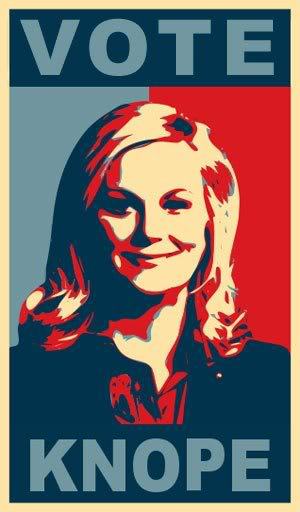
Bruno Latour and Leslie Knope
Juxtapositions are frequently fruitful. I am not sure where this one is going, but it's pretty sweet.
 I've been re-reading Bruno Latour's Aramis and re-watching Parks and Recreation. Shot in the documentary style of The Office, the show increasingly strikes me as a performance of what Latour describes in Aramis as a "relativist sociology": "It does not know that society is composed of, and that is why it goes off to learn from others, from those who are constructing society" (200). Parks and Recreation is a portrait of government in action. Leslie Knope, of the Love of Local Government.
The show, at its finest, performs the work of negotiation and compromise that, in part, shapes civic life. In re-watching these moments with Aramis by my side, I can't help but see Leslie through Latour's eyes:
Part of the reason I love the show is its tempered faith in bureaucrats. Leslie Knope, the deputy director of the Pawnee, IN, Parks Department and star of the show, is an earnest, hardworking civil servant. She does her job amidst the incommensurability of democracy, balancing the angry feedback she receives at public forums, this disinterest and/or lack of faith in government, the libertarianism of her boss, budget constraints, etc. (The episode in Season Three when Leslie and the Parks Department pull-off the Harvest Fest may provide one of the most satisfying endings of a sitcom episode ever.)
I'll grant anyone, for the moment, any joke or insult about civil servants and bureaucrats. Yes, yes. But I ask, in light of the kind of sociology that Latour proposes, what does such a view, nearly ubiquitous outside of Parks and Recreation, get us? How do we benefit from demeaning such work (other than getting exactly what we deserve)? How do we learn to do it better by dismissing it out of hand? In rushing to judgement, we glass over the decided-ness of what we hold near and dear. We short-circuit democracy.
I'd argue that lurking beneath such a short-circuiting contempt is what Latour calls "classical sociology":
As Leslie says of her first public forum (which goes terrible and to great humorous effect): "God I loved it. I loved every minute of it!"
 I've been re-reading Bruno Latour's Aramis and re-watching Parks and Recreation. Shot in the documentary style of The Office, the show increasingly strikes me as a performance of what Latour describes in Aramis as a "relativist sociology": "It does not know that society is composed of, and that is why it goes off to learn from others, from those who are constructing society" (200). Parks and Recreation is a portrait of government in action. Leslie Knope, of the Love of Local Government.
The show, at its finest, performs the work of negotiation and compromise that, in part, shapes civic life. In re-watching these moments with Aramis by my side, I can't help but see Leslie through Latour's eyes:
Bureaucrats are the Einsteins of society. They make incommensurable frames of reference once again commensurable and translatable. The protocol of agreement, red-penciled and ratified, starts moving again, going from one reference body to another, tracing a path along the way, a succession of fragile catwalks that make the agreement harder to break each time, because it is now weighed down with the word of the State.
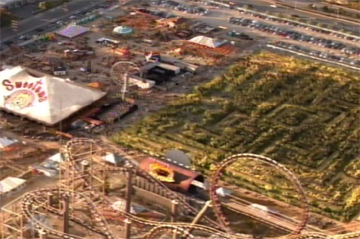 |
| Final shot of "Harvest Festival" |
I'll grant anyone, for the moment, any joke or insult about civil servants and bureaucrats. Yes, yes. But I ask, in light of the kind of sociology that Latour proposes, what does such a view, nearly ubiquitous outside of Parks and Recreation, get us? How do we benefit from demeaning such work (other than getting exactly what we deserve)? How do we learn to do it better by dismissing it out of hand? In rushing to judgement, we glass over the decided-ness of what we hold near and dear. We short-circuit democracy.
I'd argue that lurking beneath such a short-circuiting contempt is what Latour calls "classical sociology":
There are norms, and thus there are deviations with respect to the norm; there are reasons, and thus there is irrationality; there is logic, thus there is illogicality; there is common sense, and thus perverted senses; there are norms, and thus there are abnormality and anomie. (199)When I watch Parks and Recreation I am not watching a documentary where "the actors are informants," telling what they did so that we can pass judgement (although certainly this happens: I can easily imagine a classical sociological viewing of the show). For me, I am watching government in action. Parks and Recreation is not a show where common sense, and logic, and reason are outside measures applied to political behavior; it is, at its best, a show where common sense, logic, and reason are all the end results--the effect--of political behavior. For instance, the reasonableness of the park Leslie wants to put in the vacant lot (this is the primary arc of season one) cannot be known ahead time: its reasonable-ness, its sensical-ness, its feasible and, finally, its reality are precisely what is being worked on. To borrow from Latour, things like logic and common sense "follow; they do not lead. They are decided; they are not what makes it possible to decide" (184).
As Leslie says of her first public forum (which goes terrible and to great humorous effect): "God I loved it. I loved every minute of it!"
Saturday, March 10, 2012
French Accountants
In my current struggle with "accounting" for the nonhuman, Latour's Aramis again proves helpful:

Of course you have to "take into account" all the elements, as people say naively, but only the not very innovative projects know in advance which accountant to believe and which accounting system to choose.The consequences of these choices will multiply, we suppose, at the level of the city, as in the case of Urbanized.

Subscribe to:
Posts (Atom)