Showing posts with label politics. Show all posts

Thursday, April 26, 2012

Deep (Environmental) Ambivalence (And TROLLS!)

I have previously discussed (here and here) my interest in developing environmental historian William Cronon's "deep ambivalence" with respect to "wilderness" as an environmental rhetoric in its own right. Here is a quick refresher on Cronon's "deep ambivalence." Cronon writes of being "forced to confront [his] own deep ambivalence about [wilderness's] meaning for modern environmentalism." On the one hand, he argues, the notion of wilderness disconnects humans from their environment and thus often produces irresponsible behavior. That is, we let ourselves off of the hook when we take ourselves out of nature.
On the other hand, I also think it no less crucial for us to recognize and honor nonhuman nature as a world we did not create, a world with its own independent, nonhuman reasons for being as it is. The autonomy of nonhuman nature seems to me an indispensable corrective to human arrogance.
So I am interested in deep ambivalence as mode of engagement (an environmental attitude) and I am interested in seeing what can be done with wilderness as a rhetorical object. Tim Morton (who writes both about ecology and object-oriented ontology) is helpful on both counts.

What I have been calling "wild objects" (in an attempt to re-cycle "wilderness" in terms of OOO) Morton calls the "strange stranger," a term I would adopt were I not specifically interested in working through the environmental rhetoric of "wilderness." Morton writes, "Life-forms recede into strangeness the more we think about them, and whenever they encounter one another—the strangeness is irreducible" (165). From here, Morton goes on to argue that "ecological philosophy that does not attend to this strangeness is not thinking coexistence deeply enough" (165). The same, I obviously want to argue, is true of environmental rhetoric, which often un-stranges the stranger in doing its work. Writing about the story of climate change, Bronislaw Szerszynski argues,
This story is one in which the diagnostic task of establishing the truth of anthropogenic climate change naturally gives way to the practical one of finding effective political and technical responses to it. (10)
I would argue that Morton's admonishment is even more relevant for environmental rhetoric as rhetoric, following Kenneth Burke, is largely about persuasion to attitude, which is incipient action. The assumption that getting the diagnosis right naturally leads to changes in behavior assumes both that we could ever "get it right" and that it's information alone that leads to action (rather than the matrix of personal, social, affective, and environmental forces that cultivate attitudes). Both of these assumptions are problematic.

Wild objects, especially as I want to read them through my continuing obsession and employment of The Troll Hunter, really get fleshed out as Morton writes, "The more we know about a strange stranger, the more she (he, it) withdraws" (166). This works rather well for my reading of The Troll Hunter as an object-oriented environmental rhetoric: the whole apparatus of the film is designed to bring us into close contact with the troll in order to reveal its strangeness. We have the information forms produced by the Troll Security Service (TST), the lessons about types of trolls, the history, the legends, and even the blood work, but all of this pushes the trolls further and further away. The weirdness and wildness and strangeness of the troll is increased even by the film's documentary style, which, as styles go, promises a certain immediateness. Morton writes, "Bizarrely, increase access (technically possible or not, hypothetical or not) does not decrease strangeness" (166). Again, this line of thought in Morton and weirdness in The Troll Hunter resists the normal way we approach environmental rhetoric, which typically insists on truthful (read "complete") representation of the object. In other words, we have to get it right to even begin to save it. The Inconvenient Truth and its line graphs is a perfect example this kind of environmental rhetoric. As Morton argues, "It's not simply a case of the right equipment passing through it like a knife through butter" (177). Objects do not need to be kept wild: objects remain wild even in the midst of interaction.

Now, the question of interaction leads necessarily to a discussion of the nature or mode of that interaction. Morton discusses melancholia as the mode of subjectivity that OOO utilizes, and Morton's melancholia, I think, feels a lot like Cronon's deep ambivalence.
Melancholia is precisely the mode of intimacy with strange objects that can't be digested by the subject. (175)
What Morton thus proposes is a mode of interaction—what (Kenneth) Burke calls attitude (which is emotional and physical, affective and social)—predicated on strangeness. Melancholia is not the resignation of depression; it is a mode of intimacy and thus of interest and engagement. And so melancholia resonates with Cronon's deep ambivalence, which is itself not a resignation but a recognition (and respect) of strangeness—the stuff that cannot be reduced to us, decoded by us, or controlled by us.


The consequences of escaping (or shaking off) our melancholia are dire. "Melancolia," Morton writes, "starts to tell us the truth about the withdrawn qualities of objects" (176). Furthermore, and here I turn back to Morton's Ecology Without Nature, where he writes of the need for "the openness of this whatever, pronounced with the distracted yet ironic casualness of a California high school student" (158). (Morton's discussion of modes of distraction in Ecology syncs with melancholia.) Without this whatever or this melancholia, "the ecological collective to come will be captured by the fantasies of nation building that have haunted the concept of nature" (158). To this I would add Szerszynski, who writes the following of a rather un-melancholic approach to ecology:
To put this another way, climate science’s action-orienting power derives not from its objectivity, autonomy and disinterestedness, but from its always-already presumption of application. Our relation with the weather has been pulled towards a certain kind of reading that constitutes it as a code that can be mastered and controlled. The metabolic relation of humanity and nature has been understood only in narrowly causal terms, obscuring the disseminative drift of meaning and thus tilting us inexorably towards the idea of climate change as a problem that can be solved rather than an opening to be responded to. (19)
This opening can only be responded to in the melancholic mode of Cronon's deep ambivalence, which is neither resignation nor a fantasy of decoding or of nation building. Deep ambivalence, like melancholia,
is the default mode of [object-oriented] subjectivity: an object-like coexistence with other objects and the otherness of objects—touching them, touching the untouchable, dwelling on the dark side one can never know, living in endless twilight shadows (176)
Deep environmental ambivalence supposes an inconvenient truth that can never be charted. Deep ambivalence is wrapping your heart and mind around (or perhaps pouring them into) a wild object around which you cannot completely wrap either.

Wednesday, April 4, 2012

Mini Podcast: Object-Oriented Environmental Rhetoric

Here is a short, two-and-a-half minute podcast about my current research project, about which I have previously blogged. Here is a link to the discussion of William Cronon I mention in the podcast. I used Audioboo, a free application for the iPhone. Enjoy!

Thursday, March 15, 2012

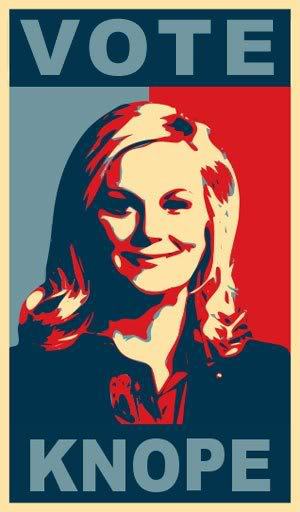
Bruno Latour and Leslie Knope

Juxtapositions are frequently fruitful. I am not sure where this one is going, but it's pretty sweet.

I've been re-reading Bruno Latour's Aramis and re-watching Parks and Recreation. Shot in the documentary style of The Office, the show increasingly strikes me as a performance of what Latour describes in Aramis as a "relativist sociology": "It does not know that society is composed of, and that is why it goes off to learn from others, from those who are constructing society" (200). Parks and Recreation is a portrait of government in action. Leslie Knope, of the Love of Local Government.

The show, at its finest, performs the work of negotiation and compromise that, in part, shapes civic life. In re-watching these moments with Aramis by my side, I can't help but see Leslie through Latour's eyes:
Bureaucrats are the Einsteins of society. They make incommensurable frames of reference once again commensurable and translatable. The protocol of agreement, red-penciled and ratified, starts moving again, going from one reference body to another, tracing a path along the way, a succession of fragile catwalks that make the agreement harder to break each time, because it is now weighed down with the word of the State.
Final shot of "Harvest Festival"
Part of the reason I love the show is its tempered faith in bureaucrats. Leslie Knope, the deputy director of the Pawnee, IN, Parks Department and star of the show, is an earnest, hardworking civil servant. She does her job amidst the incommensurability of democracy, balancing the angry feedback she receives at public forums, this disinterest and/or lack of faith in government, the libertarianism of her boss, budget constraints, etc. (The episode in Season Three when Leslie and the Parks Department pull-off the Harvest Fest may provide one of the most satisfying endings of a sitcom episode ever.)

I'll grant anyone, for the moment, any joke or insult about civil servants and bureaucrats. Yes, yes. But I ask, in light of the kind of sociology that Latour proposes, what does such a view, nearly ubiquitous outside of Parks and Recreation, get us? How do we benefit from demeaning such work (other than getting exactly what we deserve)? How do we learn to do it better by dismissing it out of hand? In rushing to judgement, we glass over the decided-ness of what we hold near and dear. We short-circuit democracy.

I'd argue that lurking beneath such a short-circuiting contempt is what Latour calls "classical sociology":
There are norms, and thus there are deviations with respect to the norm; there are reasons, and thus there is irrationality; there is logic, thus there is illogicality; there is common sense, and thus perverted senses; there are norms, and thus there are abnormality and anomie. (199)
When I watch Parks and Recreation I am not watching a documentary where "the actors are informants," telling what they did so that we can pass judgement (although certainly this happens: I can easily imagine a classical sociological viewing of the show). For me, I am watching government in action. Parks and Recreation is not a show where common sense, and logic, and reason are outside measures applied to political behavior; it is, at its best, a show where common sense, logic, and reason are all the end results--the effect--of political behavior. For instance, the reasonableness of the park Leslie wants to put in the vacant lot (this is the primary arc of season one) cannot be known ahead time: its reasonable-ness, its sensical-ness, its feasible and, finally, its reality are precisely what is being worked on. To borrow from Latour, things like logic and common sense "follow; they do not lead. They are decided; they are not what makes it possible to decide" (184).

As Leslie says of her first public forum (which goes terrible and to great humorous effect): "God I loved it. I loved every minute of it!"

Wednesday, March 7, 2012

Urbanized and Object-Oriented Rhetoric, Part Two

This isn't so much a part two, as it is a revisiting of yesterday's post on the documentary Urbanized. Not too long after I clicked "Publish Post" (lying awake in bed, in fact), I began to have some regrets. In particular, my own conclusion now gives me pause:
Bad design is design that mistakes itself as purely human. If we ignore the missing masses as "we" plan, they will come back to haunt us precisely where we live.
See the trap? I have just argued, from an object-oriented perspective, that objects, or in this case the materiality of a city cannot be reduced (see Latour) to the intentionality of the designer: there is always excess. My argument makes sense, given my use of Latour. That said, how sound or practical or ontologically possible is my advice to account for missing, nonhuman, masses?

I'll here go to Graham Harman:
Behind every apparently simple object is an infinite legion of further objects that "crush, depress, break, and enthrall one another." (Tool-Being 296)
In other words, we cannot stop them from haunting us. We cannot possibly know everything about every thing and thus include any and every thing that bears upon city life. By requiring designers to ac/count for nonhumans, do I implicitly argue that every nonhuman can be fully counted? (For more on the tension between Latour and Harman, see Harman's Prince of Networks as well as The Prince and the Wolf.)

So let's try this: the best a designer or a city planner (you know, rhetors) could do is to leave room for accidents. Make a city that will bend rather than break. Perhaps that is the way of describing the limits of, in the case of Urbanized, Modernist city planning. It's not simply that they failed to account for the nonhuman (for such an accounting is fully impossible), but that such Modernism left no wiggle room for crushing, depressing, breaking and enthralling objects.

And, to make OOO more explicitly into an OOR, the designers' and planners' techne needs to leave room for tuche, which is bound to happen. Thinking more about what OOR might do, what its William Jamesian cash value is, this might be a line of thought worth pursuing (having just recently read Kelly Pender's Techne and re-read Ballif's "Writing the Third-Sophistic"). That is, in terms of an object-oriented rhetorical production/invention/action, can we think in terms of both techne and tuche? Within our plans and actions there is the irreducible materiality of the nonhuman (the object, the thing--boy I need to tighten up that terminology).

Anyway, there's my part two, my revisiting, my apology. I'll sleep better tonight for sure.

Tuesday, March 6, 2012

Urbanized and Object-Oriented Rhetoric

So I recently (and finally) watched Urbanized, the final installment of Gary Hustwit's Design Trilogy, which includes Helvetica and Objectified. While the first two documentaries look a smaller scale design (graphic design and industrial design respectively), Urbanized looks at urban design and urban planning: design at the level of society (which is certainly not to say the two previous documentaries don't bear on society as well). I have taught Helvetica in professional writing and technical communication and Objectified in a New Media and Rhetoric course. Indeed, the latter inspired this documentary that my students and I made:


The Rhetoric of the City Museum from Nathaniel Rivers on Vimeo.

And I am likely to teach all three in my Fall 2012 Problems in Rhetoric: Animal, Vegetable, Mineral course, which takes aim at nonsymbolic and nonhuman rhetoric, which I see as the key aspects of material and object-oriented rhetorics.

In terms of the nonsymbolic and nonhuman, Urbanized, like the whole trilogy, does a good job with nonsymbolic rhetoric: how we move one another in nondiscursive ways. For instance, how high quality bike lines can raise the social status of cycling and demonstrate that a person on a $30 bikes is as valuable in a democracy as someone in a $30,000 car. Watching Urbanized, I was reminded of James Fredal's Rhetorical Action in Ancient Athens, which argues that any attempt to understand Ancient Athenian rhetoric must account for the design and planning of the city of Athens itself--it's materiality.

Where the documentary falls short (and even this is unduly harsh as it does so much so well) is with respect to the nonhuman. As the film's emphasis is design, that it centers around the human should come as no surprise: those designing, building, and dwelling in cities are it's focus. (Although even here, the documentary could have attended to the materials with which the designers work and how those materials shape the design and building processes.) That said, the very materiality of the film itself calls our attention to the nonhuman: visually, the documentary is in love with the materiality of the city.


If anything, between the voices of the individuals interviewed (multiple interviewees rather than a single narrator, provide the dialogue of the documentary) and the visuals provided by the cinematographer there is an enactment of the human/nonhuman dynamic. As I watch the documentary, then, I feel the tug between the nonhuman that "speaks" for itself and the humans who claim to speak for it or reduce it to their intentions. [I'd also grant that in subsequent viewings I will find additional moments where the documentary foregrounds the nonhuman, granting it agency and ontological weight.]

In short, as I watch Urbanized I kept asking Bruno Latour's twenty-year-old question: "Where Are the Missing Masses?" And the ending of the documentary is telling in terms of how the missing masses--the nonhuman objects that are part and parcel of our urban spaces and our lives as we know them--go missing, how there are silenced or erase. The final, human voice (I can't recall the fellow's name and I don't want to look it up right now) of the documentary argues:
Fundamentally, as a species, we need things [I got hopeful] that can power our imaginations, that get our our passions going, that can give us a sense of meaning. And that is not a brick; it is not a pipe. It is an idea. That's what drives cities forward.
And while I would not totally disagree, I would say that it is precisely in the name of bricks and pipes and their agency in the movement and development of cities, that object-oriented ontology, or object-oriented rhetoric more specifically, (must) makes its intervention. To reduce cities to the meaning the provide for us and the ideas we can have about or build into them, irrespective of the city's thing-ness and of the many other nonhumans that shape that city and its inhabitants, is to miss a substantial portion of what it means to be urbanized.

I would never argue that design doesn't matter; the documentary makes a pretty damn good case that it does. I would argue though that design cannot be flattened out into a solely human affair. What is buried in the documentary, underneath the persuasive argument that bad design on the part of humans produces bad effects, is that bad (however and whoever defines that) urban spaces are due in part to designers and design that ignore the rhetorical agency and ontological weight of the nonhumans that were always part and parcel of that design. Bad design is design that mistakes itself as purely human. If we ignore the missing masses as "we" plan, they will come back to haunt us precisely where we live.

UPDATE: There's a Part Two.

At some point, after I teach them, I want to write something longer and more involved about Hustwit's trilogy in light of new materialism and object-oriented ontology. That is, your feedback would be greatly appreciated.

Friday, December 2, 2011

A New Project

From my Current Projects page:
"The Shape of the World to Come: Toward an Object-Oriented Environmental Rhetoric" (In progress, 3000 words).

Abstract: This article works to develop an environmental rhetoric that gives vibrant matter its due. My argument, and it is one made by others, is that much environmentalism overemphasizes human agency. Or, in other words, in giving ourselves the responsibility to save or fix the planet, we have over-invested in our own agency, enacting the self-same hubris that results in dispositions toward the environment that environmentalists themselves might very well (and rightly) condemn. I argue that this over-investment (to the exclusion of denying and/or erasing nonhuman agency) is not the proper comportment we should have with the environment. Drawing on work in speculative realism (and related theories such as new materialism) and work in the emerging area of object-oriented rhetoric, I suggest that we can neither fully understand nor determine the environment, and that we need an environmental rhetoric concerned with inventing and shaping attitudes alive to this suggestion.

Monday, October 17, 2011

Intensity

As readers of this blog know (when it was active as many as a five of you), I frequently bemoan the ubiquitous use of the depth/surface distinction (and its kin: real/fake, natural/artificial) in public life. This goes back, as much does, to Plato's Socrates's distinction, for instance in the Gorgias, between true arts such as medicine and false arts such as cosmetics. In contemporary life, we have superficial changes and superficial policies and superficial responses. They don't really do anything; they just appear to.

I get it. I am often with those that make such criticisms. There is obviously a difference between adding a sign to a store's front door and changing the store policy inside. If the door says "No Shirt. No Shoes. No Service" and yet I am never removed from the store when I am barefoot and bare-chested, then it makes sense to remark that something is off here--that no real change has taken place.

However, I'd like to imagine other ways of addressing this kind of disconnect without relying on the surface/depth superficial/real distinctions. My "for instance" here would be the notion of intensity. Rather than working from the binary of the "superficial" and the "real" (in part because even a "superficial" change is a "real" change), we can describe changes, policies, responses, etc. as more or less intense. Changing the sign on the door but not the treatment of the shirtless customer inside would no longer simply by superficial but only less intense. I think intensity nicely calls attention to the qualitative rather than quantitative differences in enactment and effect. Telling some to stop, yelling at someone to stopping, and physically intercepting someone are not in different categories (superficial and real) but rather register different levels of intensity, and, depending on the context, effectiveness.

It's something I have been thinking about lately, and hope to think more about soon.

Wednesday, September 1, 2010

You Are Where You Picnic

Sarah Williams Goldhagen, architecture critic at The New Republic has a splendid review of and essay on several, recently completed public parks (including Chicago's Millennium Park, pictured below). Like the environmental artist Christo, Goldhagen, in this and other essays, treats of the political, social, and economic work that gives rise to architectures and the the political, social, and economic work done by architectures. She thus treats, in my mind, the double work of rhetoric and materiality. The architecture,as the material, works to shape the public, its movements, its values, and its future. However, the material, the architecture is not pre-specified and automatic: it must be made and it is made rhetorically.

Friday, July 9, 2010

The Positions We Are Given

Reading Everitt's Cicero, more things continue to strike me both about Cicero and rhetoric. Many have argued, myself included, that the ethos of the rhetor emerges from rather than proceeds rhetorical interaction. Ethos is as much a given as it is a got. This is clearly the case for Cicero whole struggle for and against various emergent ethoi his entire life. He worked hard to establish himself as a successful advocate. Once in positions of political power he worked to secure his reputation (by writing self-promotional works), which were often criticized by his opponents. He also struggled against his status as a "New Man": he lacked "then appropriate blue-blooded pedigree" (14). That is, his ethos continually reemerge within the shifting political climate of republican-becoming-imperial Rome.

Just as important, however, were the forces that shaped Cicero's political views and positions. Cicero moved from an optimate to populare on several occasions. He was sometimes with Pompey and sometimes with Caesar. He often represented both friends and enemies in the courts. History is harsh on those who are found, at different points in time, to occupy competing positions. And, often, rightly so. However, I would argue that our rush to judge harshly marks the instability of political views and position--including our own. In other words, we judge others for switching positions so that we might maintain the view that we pick at all.

The notion that we freely choose our views is easy to complicate in the case of Cicero because of how personal politics were in Rome. Tullia, Cicero's beloved daughter, chose for her third husband "a reckless and womanizing playboy" (200). Cicero did not approve. They were further, political implications. Cicero was, at the time, the governor of Cicilia (a position he was assigned in the wake of new laws about the duties of former Counselors). The previous governor, one Appius Claudius, had decided to stick around. This created several problems with respect to Cicero's ability to govern and protect the province. Cicero had "chosen" the diplomatic path: don't piss Appius off so that he might, at least, not work deliberately to make things difficult. This choice made sense given the fragility of the situation in Cicilia and in Rome. And the arrangement was working.

That is, until Tullia married the playboy Publius Cornelius Lentulus Dolabella, who was just then bringing Appius to trial "on a treason charge" (200). Cicero, by virtue of his daughter's marriage, found himself positioned against Appius. "Here I am in my province paying Appius all kinds of compliment, when out of the blue I find his prosecutor becoming my son-in-law" (200). This situation, thankfully, took care of itself when Cicero's term (his position) as governor ended. Cicero was also coming to terms with Publius as a son-in-law: "We all find him charming [...] He is clever and agreeable as you please. Other characteristics, of which you are aware, we must put up with" (200).

We are agents making choices to be sure; we are not, however, the only agents. Circumstance, the actions of others, often choose for us. This is not to say that we cannot struggle, but it is to argue that rhetoric (and its critics) must acknowledge that the moment, more often than not, seizes us. And, in such moments, we must muddle through, which seems to be the strategy that most aptly describes the life and times of Cicero.

Tuesday, April 6, 2010

U.S. Board on Geographic Names

Easter Break and trip back to S. Indiana (which entails intermittent internet access) has prevented me from blogging for a bit. I am going to sneak a short one here to get back into the swing of things.

This from a Los Angeles Times story on the agency, named in my title, that is
responsible for deciding the names of natural features, including glaciers, mountains, valleys, rivers and ponds.
Now, I obviously love this sort of thing because it draws attention to the inherently political/rhetorical act of naming: no naming is value-free or "innocent." Additionally, the presence of a board to adjudicate such matters (the board does not propose names; it only acts on suggestions from citizens) reminds us that because naming is value-laden it is necessarily contested. Names matter and so we fight about them (or, better yet, we all know they are important because we fight about them, which is to say that if they were indeed value-free and innocent we wouldn't care one way or the other: the proof of my argument is in the argumentative pudding).
Soon the naming authority will find its own name in the spotlight.

In an upcoming decision, the panel will take up a controversial request by a Bay Area man who filed a request to change Mount Diablo in to Mount Reagan because he finds the name, Spanish for "the devil," to be offensive. His request touched off a flood of Internet opposition, and the Contra Costa County Board of Supervisors voted against the idea and sent an opposition letter to the federal panel.
Given that the board has recently approved the name "Devils Anvil Peak," it seems unlikely that they will likewise find "Mount Diable" offensive. Now, of course there will be cries of "politicization of the naming process" and howls of "why does everything have to be so political?" I have suggested it is inherently political, and I would suggest that such instances serve as uncomfortable reminders of this. And I would conclude this short blog by suggesting that complaints of "politicization" come not just from those who disparage politics but from those who lose naming contests.

Friday, March 26, 2010

Gut Over Glut

Introduction
In 1990 Carolyn Miller took decision science ("a theory of choice with an accompanying battery of 'decision aids' for 'modeling problems of choice' in management and public policy"(163)*) to task for both what Wayne Booth calls motivism and for what Chaim Perelman refers to as reducing "problems of action" to "problems of knowledge." Miller dings decision science for a few other things; I am interested only in these two for my present purposes (as I am likewise thinking about my Computers and Writing presentation in May): the dangers of motivism and the action/knowledge problem in public life and how rhetoric should respond pedagogically.

Troubling Decision Science
Miller defines decision science as a kind of rhetoric in that it is a "theory of choice" (163). Nevertheless, Miller argues it is a problematic rhetoric because it abdicates or avoids reasoning about values, what Booth terms motivism. My more cynical response is that those folks in economics and management who typically employ decision science are avoiding addressing values purposefully to prevent them from being challenge (but this is, perhaps, another problematic kind of motivism that Burke admonishes against).

The second issue Miller addresses is how decision science boils problems of action (what should we do? should we do something at all?) down to problems of knowledge (how much will is cost? what are the risks and rewards?). The problem is that in reducing action to knowledge decision science erases conflict and avoids the question of values.
Problems of action involve conflict between people; even solitary deliberators negotiate conflicts between possible versions of themselves. Problems of action are "essentially contestable"; problems of knowledge are not. (175)
Decision Science Troubles the World
For example of how both aspects of decision science problematically operate out in the world (one of Miller's chief concerns), I would draw our attention to the NOVA documentary "The Spy Factory". The oddly titled documentary explores the role of the National Security Agency (NSA), in combination with the FBI and the CIA, in the "intelligence failures" preceding and following the 9/11 terror attacks. In particular, the issues of motivism and problems of action/knowledge show-up in the Bush administration's response to those attacks. (Obviously, this blog post is limited and much of the work now being done within the intelligence services is to be commended. This post and the documentary it draws on have a necessarily limited perspective. That being said, I am responding to stated desires and policies.)

In brief, the Bush administration's response was to remove barriers to searches and spying so as to increase the amount or volume of information available to our intelligence agencies. Many critiques of this policy -- beyond the legal and moral ones -- persuasively point out that information or the lack thereof was not the issue -- was not the root of the problem. There was enough intelligence in terms of raw data. Indeed, the ease with which government investigators were able to piece together the events leading up to the attacks suggests as much. The problem was a problem of action, of value-laden decision-making (not "do we have enough information?" but "should we be sharing it with other agencies and how and when?"). What was required, to borrow from Miller, was an ability to reason about values, about the culture of the intelligence community, and about how information was allowed or not allowed to circulate. Most importantly, however, reducing this problem of action to a problem of knowledge has potentially threatened core legal principles and not made us all that much safer. A primary contributor to the documentary, and a long time historian of the NSA, concludes the NOVA documentary this way:
Is this flood of information making us any safer? [...] We should have been safe the way it was [...] How much information is enough -- and won't too much information end up making the world more dangerous?
At first this seems counter-intuitive: how can too much information be a bad thing? If you are a decision scientist and assume that "if our information were more complete or our calculations more accurate, we could know with complete certainty whether it will rain today" (Miller 175), then it very much is against your intuition. However, if the problem is one of action (one of human relations and values and contingencies and probabilities), which I think it is, then it is rather reasonable to question the absolute value of information. And I would suggest, as I move to conclude this discussion in rhetoric's pedagogy, that it is precisely in the direction of intuition/instinct that we should head.

Conclusion: Rhetoric's Pedagogy for Deciding
To return to Miller's assertions for a rhetorical understanding of decision science (and for an accounting of how decision science has influenced pedagogy and so impacted decision making), I would ask what all this means for rhetoric's pedagogy. How might those of us in rhetoric teach decision-making in and against the context of decision science?

If traditionally education has been about information (P. Friere's influence notwithstanding), what do we make of such persuasive arguments against decision science, which is largely predicated upon this Enlightenment ideal? I would propose (although I am far from the only one) that rhetoric draw on recent research on instincts and gut feelings. For instance, the work on Gerd Gigerenzer and his book Gut Feelings: The Intelligence of the Unconscious is quite informative (yikes!) in this direction. I argue that an education that would avoid motivism and the reduction of action to knowledge should focus less on "information" and more on "instinct."

I like a focus on instinct because instincts become an excellent way to address how we reason about values. In essence, instincts are about response-ability. They are about patterns or habits of engagement. Instincts filter what information counts as valuable and they motivate particular actions over others. Instincts are, in other words, were the rubber of values meets the road of action. Values, however, and as Gigerenzer argues, are not beyond human (pedagogical) agency and they are not automatic. Instincts, he argues, are cultivated. Instincts are neither value free nor beyond rhetorical deliberation and persuasion. Indeed, instincts must necessarily be cultivated precisely because they are not pre-specified (we could take numerous examples of this from athletics where it is the honing of instincts that is so much a part of practice and improvement. The work of Debra Hawhee is valuable in this regard).

In addition to being a call to discuss values (or patterns of response), instincts are a way around one of the oft-described problems of teaching rhetoric, which presumes to address the contingent and situational (thus making the teaching of formulas problematic). Rhetoric strikes me as instinctual (which are always geared towards problems of action) rather than formulaic (which strikes me as largely focused on problems of information). I would argue that what we (should) teach are instincts. In so arguing, I necessarily invite a discussion about what kinds of instincts. And it is a discussion of what instincts and what values we should teach that potentially protects us from the troubles of decision science and from the charge of motivism, which is as damaging to teachers as it is economists.

*Miller, Carolyn R. "The Rhetoric of Decision Science, or Herbert A. Simon Says." The Rhetorical Turn: Invention and Persuasion in the Conduct of Inquiry. Ed. Herbert A. Simon. Chicago: University of Chicago Press, 1990.

Tuesday, March 9, 2010

Census Communus

Yesterday we received our pre-Census letter, which informs us that the 2010 Census is on its way. The letter, however, does more than this: it attempts to persuade us that completing and promptly returning the 2010 Census is vital. Let me start by saying that so do I. I think it is important that everyone is counted so that everyone, in a certain way, counts. This does not mean to say that I think the Census is perfect. There are important debates about how it counts, how it organizes people into categories, etc. What I find interesting about this letter is the particular pitch it makes and what that pitch says to us about what we think democracy is all about.

A colleague of mine in the Government Department has written a book, Democratic Faith, that describes what he calls "a state of quiet crisis" in democratic theory. His introduction, which is all I have read so far, explores the tension between the idea that democracy "takes men as they are" and the idea that people must be fashioned for democratic life. "While claiming to take 'men as they are,'" he writes,
democratic theory from its inception, even to its dominant contemporary expressions, exhibits anything but satisfaction for the civic capacities of ordinary humans, and seeks, sometimes to a major extent, to alter that condition for democratic ends.
As a teacher and researcher in rhetoric and writing, I can attest to this tension, while freely admitting that I do not feel it as strongly. I very much see my pedagogy as focused on something like citizenship: that the ability to engage others rhetorically through writing and other forms of composition is vital to the life and health of democracy. I see cultivating (better) citizens as necessary because I do not find democracy (nor any other form of government) "natural." I do not feel that if only we somehow removed all external forces humans will naturally desire democracy.

I believe this, in large part, because much of my research is centered around the idea that much of what we take as "natural" in human beings is cultivated or inculcated. Forms of government do simply arrive after the fact of subject formation and then are either accepted or rejected (America's recent efforts at "nation building" certainly point to this fact). Societies, with their cultures and forms of government, fashion their own subjects both implicitly and explicitly. I see my pedagogy as in largely in the "explicitly" category. A government is not simply added to already existing subjects, but is, in many important ways, the sub-stance of subjectivity itself. But this moves me in other directions.

So I return then to this pre-Census letter:
Your response is important. Results from the 2010 Census will be used to help each community get its fair share of government funds for highways, schools, health facilities, and many other programs you and your neighbors need. Without a complete, accurate census, your community may not receive its fair share.
Obviously, one would take more time and care in conducting a fully rigorous rhetorical analysis, but a few things strike me as obvious here:
  • "get" and "receive" are prominent (essentially, the same notion of "getting" appears twice in a very short letter)
  • what we get are "funds" (for important things, mind you)
What isn't mentioned, or what is implied we could say generously, are notions of representation, a sense of gaining an understanding of the changing demographic landscape of the United States, and many of the other things Census data can be used for. Also, no appeals to citizenship are made: "fill this out because you live here." "Freedom Isn't Free - All True Patriots Complete the Census."

What is valuable about democracy, this letter argues (as I have haphazardly read it) is its ability to satisfy individual or group interests. I want to be careful here, obviously. Fair and equitable distribution of resources is about more than self-interest. Indeed, the allocation of government resources is one of the primary ways we manifest our values. What I focused on is the appeal made here. The appeal is not social (I recognize the use of community and the "your neighbor" line) in any meaningful way. In fact, as I read it, "community" in the first line is always about "your community" in the last line. What about communities that are not mine--neighbors that are not mine? The 2010 Census, and thus, I would argue, democracy, is about you getting what you want. There is no sense here (or not enough for me, at least) of what my colleague in Government calls "civic excellence."

In conclusion, I am not all that impressed with this letter and the perspective on democracy it bellies (I would not, however, automatically attribute these values to the author of the document--many civil servants are clearly not just in it for themselves). Nor would I say that I am surprised. I will not, however, despair; I have a rhetoric and writing class to plan.

Thursday, February 25, 2010

Day 14: A Wee Bit of American Exceptionalism

So what seems like weeks ago I posted on the Olympics as a necessary corrective to American Exceptionalism. Today, however, I wish to engage in just a little bit of such exceptionalism (and nurse my wounded pride in the process). The U.S Women's hockey team just lost the gold medal match to Canada 2-0. While it was a heartbreaking loss, the Canadians essentially dominated. They stuffed our power play, including two five on threes. We had our chances, but Canada was just consistently too good

That being said (and with all due credit to Canada), I feel that this Canadian win is partially a win for America. Let me explain. There are 22 women on the Canadian hockey team roster. Checking on their bios (available through NBC.com), I find that 12 of the 22 attend or attended and play or played hockey for American universities and colleges.

Now, I mean no disrespect to Canadian universities; that is not the issue here. The issue here is that over half of the Canadian women's hockey team honed their skills in the United States. I mean to argue that U.S. institutions played some part in the success of this year's gold medal winning Canadian hockey team. I take is at point of pride (acknowledging the complex issues related to the place of international students in American universities) that these Canadian women found in American universities a chance to pursue their educational and athletic goals.

Give us your tired, your poor, your Olympic hockey hopefuls.

Monday, February 15, 2010

Day 4: The Trouble with the IOC

I have had resentment brewing about the IOC since they decided, in their infinite wisdom, to remove softball (as well as baseball) from the Olympic docket. And as I watched the Canadien (see, I am cosmopolitan) women’s hockey team score eighteen goals against Slovakia, I begin to ferment resentment yet again.

Sports dominated by non-European teams have had a tough time as of late. And sports with large or growing European followings are poised to compete for newly minted gold medals in future games. As of the 2008 Beijing Summer Olympics, softball and baseball are no longer Olympic sports, while at the same time the IOC considers including gold and rugby the next time around.
Baseball and softball are out of the Olympics as of 2012, in a vote that surprised even longtime International Olympic Committee members. (Source)
With respect to baseball, the list of reasons offered is slightly respectable (the absence of Major Leaguers when the NBA sends its stars and the reputation of major league baseball in terms of drug testing are two such reasonable “objections”). However, none of these is applicable in the case of softball, where the best players always compete in the Olympics. In short, it seems pretty clear that softball was removed because North American and Asian teams dominate it. This map represents (in blue) the countries that participated in softball at the 2008 Beijing Summer Games.


The New York Times reported in July of 2005 (I said this had been brewing for a while):
Softball had no such consolation. [That is, a list of reasonable "objections."] The sport worked for 30 years to become part of the Olympics. Since 1996, the United States team has produced some of the biggest stars of the Games and helped increase women's participation in the Olympics, also one of the I.O.C.'s goals.

The main criticism was that the United States team was so dominant. It went undefeated in the 2004 Games but has received strong competition from Australia and China.
In fact, the United States lost to Japan in the Gold Medal game at the Beijing games: several commentators remarked that this lost was (unintentionally) U.S. softball's greatest contribution to mainting softball as an Olympic sport. In addition to this "timely" loss and the larger, 30 year effort for Olympic inclusion, U.S. softball made efforts to promote the sport internationally, including sending equipment and inviting international competition.

Even the complaint about the lack of competition rings hollow when compared to similar dominance in other Olympic events. In basketball, the U.S. typically (since 1992) dominates (with the exception of the Athens' games in 2004). The big difference in this case is that basketball is hugely popular in Europe. It isn't just dominance; it is dominance relative to interest (and thus immediate potential).

The ultimate irony in all of this is best captured by famed female golfer Annika Sorenstam of Sweden:
[She] said inclusion in the Olympics would trigger golf's growth worldwide. "The amount of golfers in the last 10 years really hasn't increased," she said. In the long-term, it would attract "new players from different countries. It would be fabulous." (Source)
If the complaint is a lack of competition, it makes little sense to cancel it, particularly when non-European countries have become increasingly competitive in sports historically dominated by Europeans. For instance, this year’s compelling performance by the U.S. Nordic Combined team, which one the first ever medal for the U.S. in this sport. This success, then, informs my response to the exclusion of softball. As does this:
Ron Radigonda, the executive director of USA Softball, said the number of nations playing softball had jumped to 127, ranking softball 14th on the list of 28 sports. (Source)
If you include it, they will come.

Sunday, February 14, 2010

Day 3: Whither America?

I have been enjoying and appreciating the efforts of our neighbors up North. The games look great (I really like the color scheme of the games, for instance), and they are valiantly struggling against uncooperative weather. I have likewise enjoyed the outpouring of Canadian nationalism. In contrast to their typical modesty, Canadians’ have responded to their Prime Minister’s call to arms.

I like this outpouring, because, as an American, I think I am almost too close to Canada to understand how it is not America. I keep hearing Mike Meyer’s joke about “eating Canadian” tonight. Their geography is quite different from ours and their system of government is distinct (they still have a queen, for instance). Beyond that, however, I am embarrassingly ignorant.

Of course, I suspect my enjoyment has nothing in particular to do with Canadians being really excited about being Canadian. I think what I like is seeing countries other than America being excited about themselves. The Olympics are an important and necessary antidote to American exceptionalism.

The Olympics (even through our National media – which necessarily covers the games from our perspective, as I assume other nations’ media do) celebrate all nations, big and small, ally or not. It’s politically messy (heck, I’ll be complaining about this tomorrow when the IOC feels my wrath), but this messiness draws attention to the present-ness of other countries, their needs, values, and expectations. Sometimes North and South Korea compete together; sometimes they do not. Ireland proves a necessary opening ceremony buffer between Iran and Israel. At these moments we must (as in should) think about how these places see each other and themselves independent of us. I guess I am saying I like the Olympics for the same reason we like literature and drugs: it is another chance to not be trapped by ourselves in ourselves.

Perhaps ironically, what makes the Olympics additionally interesting is that despite this balm for the rash of American exceptionalism, I find myself particularly patriotic during the Olympics. I’ll celebrate athletic excellence in and of itself as much as the next cosmopolitan fellow, but I’m watching the medal count like a patriotic scoundrel.
Combining these two instincts (a rejection of exceptionalism and a performance of patriotism), I can root for my country not as an exception but as an equal participant in an international community event: because I'd like to be a patriot in a country that is uniquely my own, but which must responsibly share the stage with other countries unique in their own right.

Friday, February 12, 2010

Day 1: Olympic Rhetorics

The Olympics start tonight. Well, they have already begun, in a sense, with the tragic death of an athlete during a practice session. The Olympics are always ambiguously positioned in terms of their relationship to politics: that is, the Olympics are seen as apolitical in as much as they are attempts at international politics. It’s the oldest political tactic in the book: claim your politics are not political. Hence the ridiculousness of this argument about the 2008 Summer Olympics in Beijing:

Bush himself and other senior U.S. officials have said on several occasions that the president will attend the Beijing Olympics and believed the Olympics is not a political event but a chance for athletes to compete at the top of their class. ("Bush to attend," emphasis added)
Of particular interest to me, however, is the politics of sports (read “rhetoric of sports”). That is, not only do the Olympics as an international event enact a politics, sport is itself shot through with politics (with choices, with policies, with values, with power). And by the “rhetoric of sports” I do not just mean “talk about sports.” Rhetoric is certainly discursive, but rhetorical action operates across bodies and environments as well. For instance, I have an entire dissertation chapter devoted to the cultivation of Usain Bolt. I argued there that Bolt’s physical excellence is not innate or inborn but is an emergent phenomenon cultivated rhetorically across attitudes, commitments, techniques, the preferences of coaches (if a coach thinks you are too tall to the run 100m he or she won't let you train for it) as well as cultural and racial assumptions. The bodies of athletes are themselves political, as the example of Bolt works to illustrate. Athletes emerge from within a complex matrix of bodies, cultures, technologies and environments. What sports are available, what bodies are preferred, and how bodies are shaped by participation in sports are a just a few of ways rhetoric is embodied and enworlded and how bodies are cultivated rhetorically. This is why I really like the above logo for this year's games. The figure in the logo is constituted by the various human habitats represented by the colors of the Olympic rings: bodies are independent from neither politics nor environment.

Finally, excellence in sports (who is good and why) is likewise difficult to finally determine. There is no one reason why someone wins the gold medal and others do not. However, as we start the Winter Olympics we should be on the look out for narratives that attempt just that: hard work and talent are particular favorites, but neither packs much explanatory punch. From the dissertation:

Daniel F. Chambliss, a sociologists specializing in sports, argues that athletic excellence, and, by extrapolation, all excellence, is not “a product of socially deviant personalities,” it does “not result from quantitative changes in behavior,” and it “does not result from special inner quality of the athlete” (72, emphasis in original). Based on his longitudinal study of Olympic swimmers, Chambliss concludes that “athletic excellence is widely attainable, if usually unsought” (78). Rather than assuming, as most do, that Olympic champions simply work harder or that they have innate talent and gifts, Chambliss argues that they simply and mundanely “do things differently” ("The Mundanity of Excellence" 73). “Their strokes are different, their attitudes are different, their group of friends are different; their parents treat the sport differently, the swimmers prepare differently for their races, and they enter different kinds of meets and events” (73). This qualitative distinction is manifested across three dimensions: technique, discipline, and attitude. A case could be made that Chambliss is essentially suggesting that the rhetoric of Olympic athletes is different. In persuasively arguing that individuals are not born champions, Chambliss posits that an Olympic swimmer is persuaded into becoming.
Chambliss argues that we use "talent" to objectify what is actually a complex series of behaviors and attitudes. Athletic excellence is something somebody does rather than something somebody has.

This is, in other words, why and how I watch the Olympics. To return to the start of this year's games, which began with the tragic death of an athlete enacting excellence, it is important to remember what is at stake in the politics of sports: bodies, their cultivation, and, at times, their destruction.